
Drought Legacies
Climate extremes are increasing in frequency, duration, and severity. Global drylands, which exhibit some of the strongest climate legacies, may be particularly vulnerable to increases in the severity and frequency of extreme climate events (e.g., droughts).
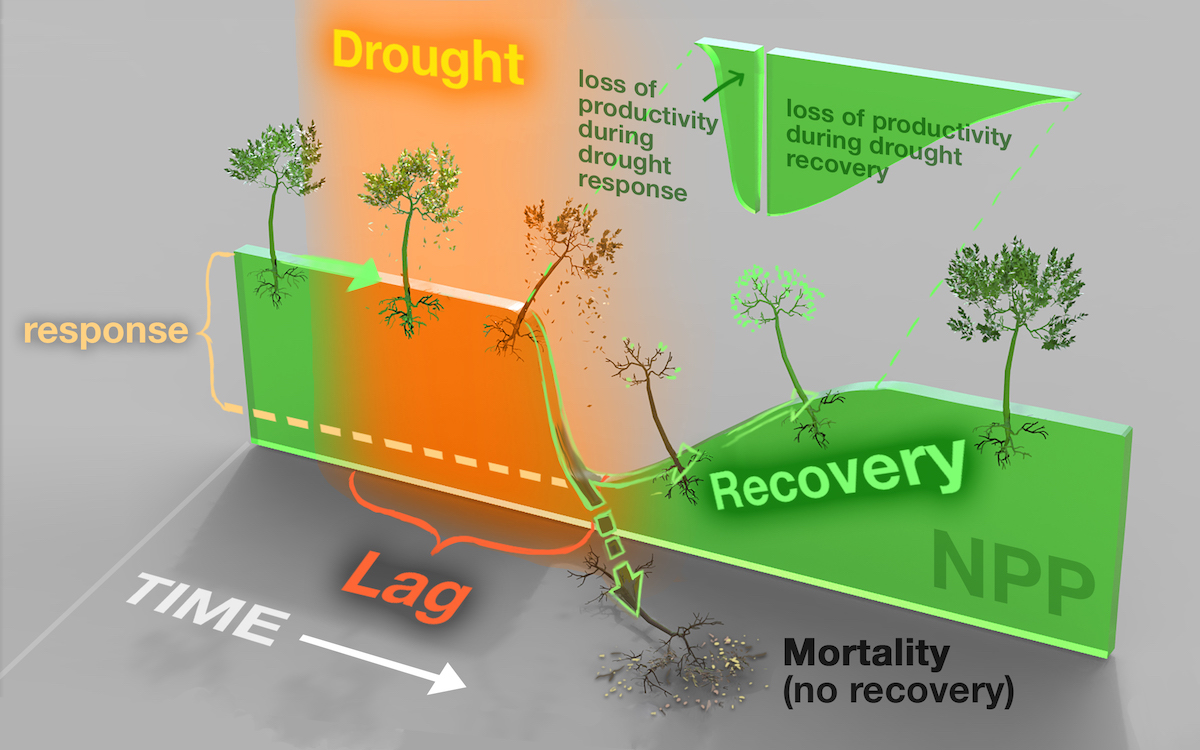
How long does a tree or ecosystem remember a drought?
Climate extremes are increasing in frequency, duration, and severity. Global drylands, which exhibit some of the strongest climate legacies, may be particularly vulnerable to increases in the severity and frequency of extreme climate events (e.g., droughts). Global drylands are defined by water scarcity and limited soil moisture, and include a variety of biomes including deserts, grassland, savannahs, and even forests. Drylands are home to over 30% of the world’s human population, and account for about 35% of terrestrial carbon uptake globally. Therefore, dryland ecosystems play a major role in governing variability in the strength of the terrestrial carbon sink. Climate extremes (e.g., droughts) are driving major changes in the distribution, structure, and functioning of drylands, with implications for the global carbon cycle. In addition, memory of past climate conditions plays an important role in governing carbon uptake and loss across a variety of spatial and temporal scales. Extreme climate events (e.g., droughts, heat waves), in particular, leave a lasting imprint on vegetation productivity and ecosystem carbon fluxes, and these “legacy effects” are insufficiently captured by global-scale models. Dr. Huntzinger is part of a team of researchers led by Kiona Ogle from NAU and the University of California Los Angeles that is working to quantify the prolonged impacts of drought on dryland ecosystems in the western US and regional carbon cycles as climate changes. In a study funded by the National Science Foundation, the team is working to quantify the legacies (prolonged impacts of an extreme event) and memory (timescales of influence of drivers, whether extreme or not) of climate-related drivers on key carbon cycle components, over a range of spatial and temporal scales across drylands in the western US.